
The Tic Tac UFO Encounter: What Was Seen and Recorded
A white, wingless object moving above a patch of disturbed ocean. That is the scene David Fravor describes from a November 2004 Navy training flight. The encounter is compelling partly because its best-known video is not a recording of that entire scene.
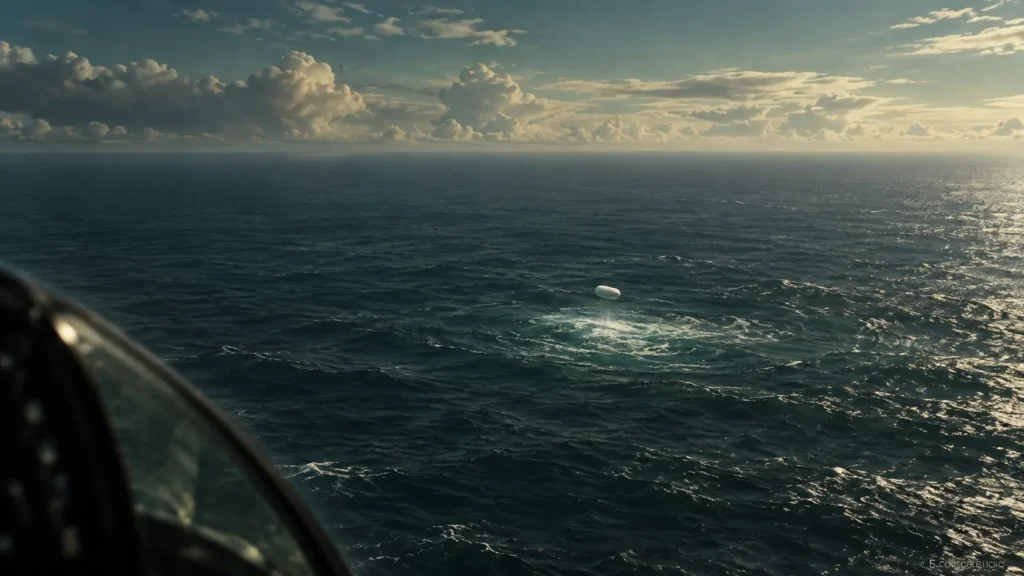
Event: 14 November 2004, during the Nimitz deployment.
Public material: first-person testimony, an official hearing transcript and a later-sortie infrared clip.
Central question: which claims can be checked against released measurements, and which currently rest on accounts?
The encounter Fravor describes
In his 2023 written statement, Fravor says his two-aircraft flight was redirected from training toward a contact. He describes calm conditions, conspicuous disturbed water and a small white object making abrupt movements. As he descended, he says the object aligned with his aircraft, climbed and then accelerated out of view. Read the original statement, pages 1–2.
Those descriptions are important as a pilot’s direct account. The reported earlier radar behavior and a later report that the contact reappeared elsewhere came through other personnel. They should be tested as separate claims rather than converted into one continuous, measured flight path.
Distance, duration and apparent acceleration also need their original basis. A vivid estimate from an observer is not the same thing as a synchronized calibrated track. Treating the distinction seriously preserves the interesting question rather than answering it by illustration.
Three pieces that often get merged
The visual encounter
This is the event Fravor and the other crew members observed from their aircraft. His statement describes it retrospectively. A full reconstruction would compare each observer’s original account and identify agreements and differences.
The radar account
Fravor recounts information supplied by the ship’s controller, including prior activity and a later contact. Independently reproducing those movements would require the relevant radar records, clocks, processing context and track associations. The testimony alone does not publish that dataset.
The familiar infrared video
Fravor says another crew launched later and made the familiar recording. The Department of Defense’s 27 April 2020 statement confirms that one of its three officially released Navy videos was recorded in November 2004. Authenticating the recording’s origin does not establish every reported maneuver in the broader story. Read the release statement.
The release date is not the encounter date
November 2004 · The reported encounter and recording.
27 April 2020 · The Department of Defense authorizes release of three Navy videos after earlier public circulation.
26 July 2023 · Fravor describes his experience before the House committee.
This timeline explains why a newly encountered clip can be old evidence. Each later retelling may add context, but repeated distribution of a recording does not create independent observations. The 2023 hearing package.
What remains a useful open question?
The public question is not only whether the story sounds extraordinary. It is whether independent investigators can connect observations, sensor records and timing well enough to measure what happened. The sources linked here do not by themselves provide a complete, reproducible dataset for all the encounter’s reported motion.
That gap does not identify the object. It tells us which follow-up would matter: original sensor products, traceable release history, independently recorded witness accounts and reconstruction assumptions that other analysts can test. A classified-data claim may explain why a source says more exists, but it cannot replace public access to that evidence.
A reconstruction should make the origin of each part visible: testimony, recorded imagery or an illustrative assumption. An invented precise trajectory would make the picture smoother while making the evidence harder to understand.
Continue the investigation
The GoFast case examines a different problem: why rapid image motion need not imply extraordinary target speed. Fravor’s source file and the hearing guide keep the underlying material close at hand.
Fravor written statement · Official oral transcript · Official imagery acquisition route
Source review: 16 October 2026. The written account, hearing record and release statement were checked. This article is a reconstruction of their relationship, not an independent analysis of unreleased radar or a frame-by-frame review of the original clip.
Found an original document or a correction? Send the claim, its date and the source to doomsday@doomsdaycounter.com.