
When Will the World End? What the Evidence Says
There is no scientifically established date for the end of the world. The useful answer depends on what “world” means: a civilisation, humanity, Earth’s habitability, the planet itself or the universe. Those are different outcomes, with different evidence and timescales.
A date can be precise while its meaning is wrong. An eclipse has a calculable time; its appearance does not establish a prophecy. An asteroid encounter can be scheduled without being a collision. A software format can have a hard limit while affected systems can still be repaired.
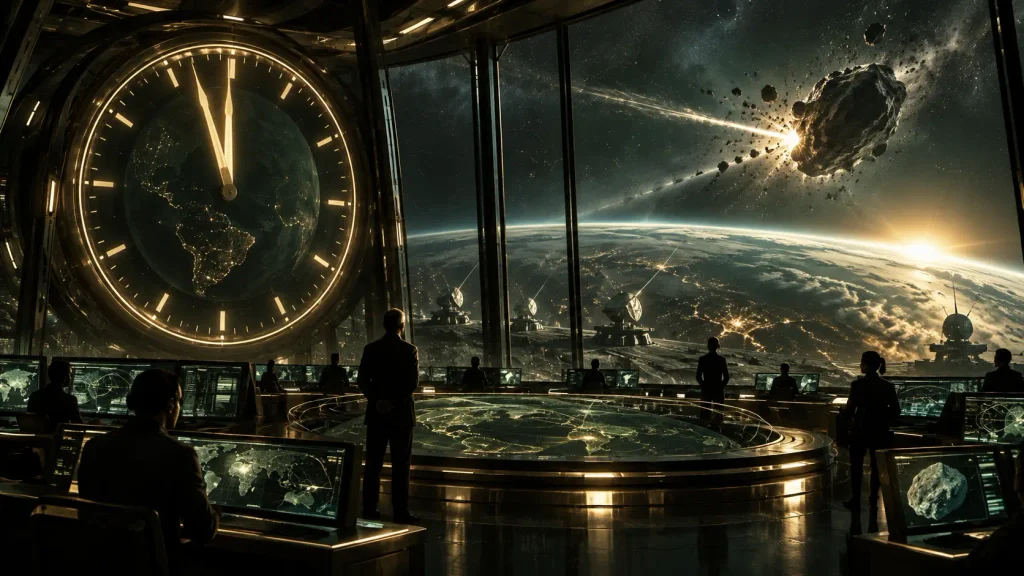
Will the world end in 2026?
The sources checked for this ledger do not establish a worldwide catastrophe scheduled for 2026. That is a statement about the evidence reviewed, not a guarantee that nothing harmful can happen. It is also not permission to attach every current crisis to a single invented expiry date.
The AI risk explainer discusses mechanisms and evidence without assigning an extinction deadline. The Amodei entry separates a possible capability timeline from a catastrophe prediction. “A powerful system may arrive” and “humanity ends this year” are different claims.
Two sourced examples behind the 2026 question
Dario Amodei’s AI timeline: In his October 2024 essay, Amodei described powerful AI as possible as early as 2026, while allowing a longer wait. That is a conditional capability expectation. The recorded versions distinguish that early possibility from his later discussion of a one-to-two-year window.
The 2026 Doomsday Clock: The Bulletin set its symbolic clock to 85 seconds before midnight on 27 January 2026. The number expresses its assessment of danger; it does not announce 85 days remaining or a catastrophe scheduled during 2026. Read the official statement and the clock’s history and meaning.
Does the Doomsday Clock predict the date?
The Bulletin’s 27 January 2026 statement set its symbolic clock at 85 seconds to midnight. Those seconds express a judgement about danger, not the remaining seconds of real time. Read what the Doomsday Clock means before treating its imagery as a forecast.
Could an asteroid end the world?
Asteroid risk is assessed object by object using observations and orbit models. Apophis’s 2029 close approach is an example where later measurements removed an earlier impact concern. Bennu’s probabilities show why a risk for one encounter and cumulative risk over many years cannot be substituted for each other.
The absence of an identified scheduled catastrophe does not prove that every object is known. It tells us to look for actual observations, the assessed encounter and the date of the calculation. A dramatic picture is not enough. Evidence should become more specific as a claim becomes more specific.
Will AI cause human extinction?
There is serious disagreement about the likelihood and course of severe AI outcomes. A useful discussion identifies the mechanism, the capability and access it requires, the observations supporting it and the interventions that could change it. A capability benchmark by itself does not establish global loss of control.
The term p(doom) is shorthand for estimates that may use different definitions and horizons. The AI 2027 scenario also needs its definitions and alternative endings attached. This site records those differences rather than treating a scenario’s title as the date of human extinction.
What about nuclear, biological and climate risks?
These risks are discussed in a separate mechanisms overview. Severity, likelihood and timescale deserve their own evidence. A regional disaster, a global emergency and human extinction should not be described as the same outcome merely because each is frightening.
Choices matter. Prevention, observation and intervention can change a risk. A countdown that hides those choices leaves the reader with an impression of inevitability that the evidence may not support. An honest record includes the possibility of a better outcome.
When will Earth become uninhabitable?
Long-term habitability involves scientific models, rather than a present-day prophecy. Compare the plant and atmosphere models with the Sun’s future evolution. Different models ask different questions: losing suitable conditions for some life is not the same milestone as the planet being engulfed.
Even farther ahead, heat death of the universe has no established calendar date. A scale associated with one late cosmic process should not be turned into the expiry time of Earth or humanity.
Why do failed predictions keep returning?
The archive records concrete cases such as December 2012, Camping’s 2011 dates and the September 2025 rapture window. Their histories show different claims and responses. A later explanation or revised date belongs beside the original, rather than erasing it.
A failed prediction does not demonstrate that every future risk is imaginary. A real risk that was successfully mitigated is not a failed prophecy either. Keeping those categories separate is what makes the archive useful.
A five-question check for any new date
Who made the claim? Where was it published before the deadline? What exactly is expected to happen? Which evidence connects the cause to that outcome? What would count as the claim being wrong? If these cannot be answered, the date should remain uncertain rather than receiving a confident counter.
Use the dated ledger and lifetime comparison to explore specific records, and the methodology to see how they are assessed. Corrections should include the original wording and a source: doomsday@doomsdaycounter.com.
Current-year source check: 26 October 2026. The historical overview was reviewed on 7 October 2026. New current-year claims are assessed individually; the year in a question does not make a prediction valid.
What is worth following in late 2026?
Follow the dated evidence updates for the new October AI assessments and WMO seasonal outlook. These are specific developments with their own mechanisms and limits. Neither supplies a scientifically established date for the end of the world.